
Quick Answer: Photoperiod plants need 18/6 (18 hours light, 6 hours dark) for veg and a strict 12/12 flip to trigger flower. Autoflowers run 18/6 from seed to harvest and never need a flip. The dark period during flower for photoperiod plants is non-negotiable. A single light leak can re-veg the plant or push it toward hermaphroditism, thus, a timer is not optional.
The grow that taught me to respect light schedules was not a dramatic one. The lights didn’t fail, and there was no major incident to heap the failure on. I just got lazy about checking the timer one week during week three of flower, and three days later I had a plant showing new single-finger leaves growing out of bud sites. The plant had to re-veg because of that slight error on my part.
The plant had been getting about 13.5 hours of light instead of 12 because the timer had drifted off its setting without me noticing. That plant recovered eventually, but it cost me three weeks and significant bud development.
Light schedule is one of those things that feels basic right up until the moment it costs you a harvest. This guide covers every schedule worth knowing, why the numbers matter, and the exact mistakes that growers grapple with at each stage.
Table of Contents
Photoperiod vs Autoflower
The schedule you need depends entirely on which type of plant you are growing, and the difference is significant enough that mixing them up produces bad results.
Photoperiod plants have their light cycles control growth, with 18/6 for vegetative and 12/12 for flowering. Autoflowering strains flower based on age, not light, making them more beginner-friendly.
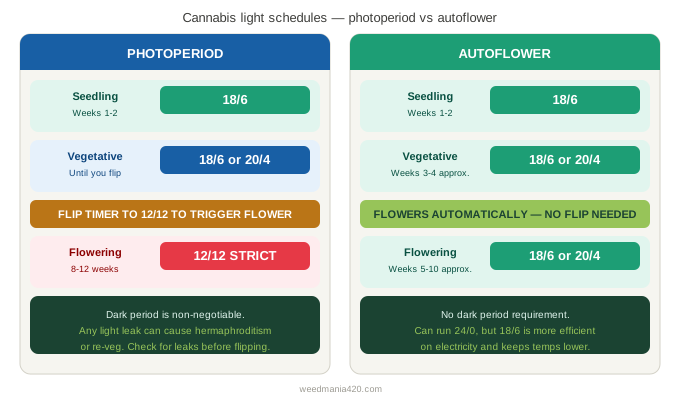
That distinction runs deeper than it first appears. A photoperiod plant is using the ratio of light to darkness as its primary signal for when to shift from vegetative growth into flower production.
When the dark period reaches roughly 12 hours, the plant interprets that as the approach of autumn and initiates flowering.
An autoflower has had that light-sensitive response bred out of it. Unlike photoperiod cannabis plants that need a specific light schedule to start producing buds, autoflowers operate on their own internal clock and automatically switch from the vegetative stage to the flowering stage based on their age, not on changes in light exposure.
This unique trait comes from Cannabis ruderalis genetics, a hardy subspecies that evolved to flower quickly in the short summers of its native regions.
Thus, photoperiod growers have complete control over when flowering starts and how long veg runs. Autoflower growers trade that control for simplicity and a shorter overall timeline.
Seedling Stage for Both Strain Types
Whether you are growing photoperiod or auto, seedlings need consistent, gentle exposure to light that supports early development without overwhelming a root system that has barely established itself.
Seedlings don’t want too much light, vegetative plants need at least 16-18 hours of light, and flowering plants need 12 hours of darkness every night.
I run my seedlings at 18/6 from the moment they break the surface, with the light sitting higher than usual and the dimmer turned down to around 40% if the light has one.
The target PPFD for seedlings is 100 to 300 μmol/m²/s, which is significantly lower than veg or flower intensity. More detail on that in the PPFD and PAR guide.
The seedling heat mat goes under the tray at this stage to keep soil temperature at 77°F. Warm roots plus gentle light equals fast, healthy establishment in the first two weeks.
Vegetative Stage for Photoperiod Plants
The standard veg schedule for photoperiod plants is 18/6, and it earns that status because it works consistently across virtually every strain and growing environment.
The vegetative stage uses an 18/6 cycle with a blue-heavy spectrum for strong foliage and roots. The 18 hours of light drives photosynthesis and growth.
The 6 hours of darkness gives the plant time to process and consolidate that growth, and it keeps your tent temperature from climbing through the night.
Some growers push to 20/4 in veg, arguing that the extra two hours of light produces faster vegetative growth. The evidence is genuinely mixed. I used a 20/4 light cycle for years and found that it increased yields over 18/6, but the gains were not huge.
For most home growers, 18/6 is the better choice simply because the marginal growth gain from 20/4 does not justify the higher electricity bill and the additional heat the light generates during those extra two hours.
What you absolutely do not want to do in veg is run 24/0 on a photoperiod plant you intend to flower normally.
Some growers do this believing more light always means more growth, but plants get 18 hours of light to grow and 6 hours of darkness to recover. If you go lower, say, 14/6 hour light periods, your plants will underperform.
So, maintain the sweet spot as plants grown under continuous light can develop strange leaf growth and stress responses that carry into flower.
How Long to Veg
This is where photoperiod growing gives you genuine control that autoflowers do not. Veg for as long as you want.
The plant will not flower until you flip the timer. Most indoor growers in a 4×4 tent run 4 to 8 weeks of veg depending on how large they want the final plant.
Longer veg builds more bud sites through training, which is why growers who top, LST, and ScrOG tend to veg longer than growers who run untrained plants.
As a general rule, flip when the plant is roughly half the final height you have room for.
Cannabis typically doubles in height during the first few weeks of the 12/12 stretch, so a plant at 18 inches when you flip will likely finish around 30 to 36 inches.
Flowering Stage for Photoperiod Plants
The flip to 12/12 is the most consequential single decision in a photoperiod grow. Make it too early and you leave yield potential on the table from an underdeveloped structure. Make it too late in a tent with limited height and you run out of vertical space during the stretch.
For the flowering stage, a strict 12/12 cycle with a focus on the red light spectrum triggers bud production.
Your lights should be on a constant cycle of 12/12, as any interruption can cause havoc on your grow. Too much light can cause your plant to revert to the vegetative stage or even turn into a hermaphrodite.
This is exactly what happened in my re-veg story above. The plant was not getting dramatically more light, just an extra 90 minutes. That was enough. Photoperiod plants in flowering are measuring the dark period, not the light period.
What triggers hermaphroditism and re-veg is a dark period that is shorter than 12 hours, not a light period that is longer. The dark period must be completely dark.
A phone screen, an LED indicator light on a power strip, a gap around a tent zipper, all of these qualify as light leaks that a plant in flower can detect.
Before flipping, do a complete light leak check in total darkness. Stand inside the tent with the zip closed for three minutes. If your eyes adjust and you can see any light source at all, fix it before you flip.
The 12/12 from Seed Method
Worth mentioning because it comes up regularly in beginner questions. Some growers run 12/12 from the very first day, skipping a separate veg period entirely.
This produces smaller plants with one or two main colas rather than a full trained structure.
The trade-off is a faster total timeline and less setup complexity. It suits small spaces and situations where plant height is a hard constraint. It is not a mistake, just a different approach with different yield expectations.
Autoflower Light Schedules
Autoflowers do not need a flip, but that does not mean any schedule works equally well. An autoflower light cycle runs on one continuous schedule from seed to harvest, while a photoperiod schedule shifts from long days to short days to trigger flowering.
Autoflowering cannabis plants flower based on age, not daylight, so the autoflowering light cycle never needs a flip.
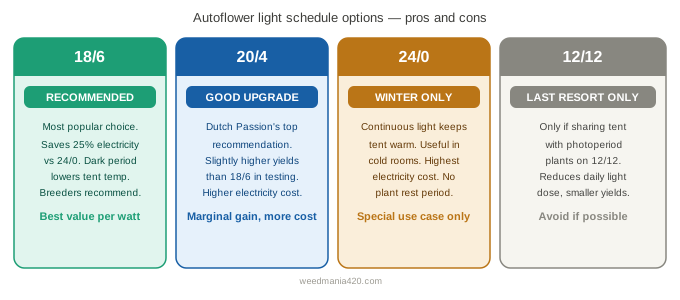
The schedule debate for autos centres on four options, and the community is genuinely divided.
18/6 for Autoflowers
The 18/6 light schedule for autoflowers is the most popular choice among home growers because it cuts electricity cost by a quarter compared to 24/0 while still producing strong yields.
The 6-hour dark period also lowers room temperature, which matters in warmer indoor setups. Most autoflower breeders recommend 18/6 as the default schedule from seed to harvest.
This is where I start anyone new to autoflowers.
It is the lowest-risk choice, the most forgiving on electricity costs, and the one with the broadest community support behind it. If nothing else in this guide sticks, 18/6 from seed to harvest will produce a solid first autoflower grow.
20/4 for Autoflowers
Perhaps the most common autoflower light schedule, and the one which Dutch Passion most often recommends, is the 20/4 light schedule. This uses 20 hours of lights-on followed by 4 hours of darkness in each 24-hour time period.
This light schedule delivers great results and seems to give the plants a healthy autoflower light cycle all the way from seed to harvest.
I have run 20/4 on a few autoflower grows and the results were marginally better than 18/6 in terms of bud density in the final two weeks. Whether that justified the slightly higher electricity bill is a close call.
If your tent runs cool and electricity costs are not a concern, 20/4 is a reasonable upgrade from 18/6.
24/0 for Autoflowers
Some growers use 24 hours of light to push vegetative growth. A 24 hour light schedule for autoflowers is often popular during cooler winter months.
The winter application makes sense: 24/0 generates more heat from the light, which helps maintain tent temperature when the surrounding room is cold.
Outside of that specific use case, the argument for 24/0 runs into the fact that the plant gets no rest period, which slightly reduces photosynthesis efficiency over time and adds heat and electricity cost to your room.
A short dark window of 4 to 6 hours gives the plant time to convert sugars and reset, and most autoflower growers see better yields per dollar on 18/6 or 20/4.
12/12 for Autoflowers
There are even growers who opt to provide their autos with a 12/12 schedule during flowering. However, note, this will reduce the size of your buds and is not actually necessary, as autoflowering plants flower based on time, not light cycles.
The one scenario where 12/12 makes sense for an autoflower is running it in the same tent as photoperiod plants that are already on a 12/12 flower schedule. The auto will flower regardless of the reduced light, though expect smaller yields than the same strain would produce under 18/6 or 20/4.
Growing Autoflowers and Photoperiods Together
It can be done, with compromises. If you run the tent at 18/6, the photoperiod plants will stay in veg while the autos flower. If you run 12/12 for the photoperiod flip, the autos will flower adequately on reduced light but not at their maximum potential.
Growers running autoflowers alongside photoperiod plants in the same tent can keep the light schedule at 18/6 throughout, as the autoflowers will flower regardless of the cycle.
This works if you are not ready to flip the photoperiod plants yet and you want to run a fast auto alongside them.
The moment you flip the tent to 12/12 for the photoperiod plants, both strains are in flower simultaneously, and the auto will finish faster and come out first.
Spectrum: What Changes With the Schedule
Light schedule and light spectrum are separate variables, but they work together.
Blue light spectrums at 6500K have been shown to encourage vegetative growth, helping cannabis plants grow short and stocky while minimising stretching.
Red light spectrums at 2700K are ideal for bloom because they encourage budding and a little bit of stretch, encouraging plants to produce big, dense flowers.
Most modern full-spectrum LED grow lights cover both ranges without any manual switching needed, but if your light has a veg and bloom mode switch, use it at the right stage.
For a deeper dive into exactly how light spectrum interacts with PPFD and DLI across the grow cycle, see the PPFD and PAR guide.
The Timer is Not Optional
Each phase of a cannabis plant’s growth requires unique lighting needs. Seedlings don’t want too much light, vegetative plants need at least 16-18 hours of light, and flowering plants need 12 hours of darkness every night.
A digital timer connected to your light is the single piece of equipment that enforces all of the above automatically. A mechanical timer with 30-minute increment pins works fine for 18/6 and 12/12, and handles the vast majority of home grow scenarios without any complexity.
The upgrade that matters specifically for flowering is battery backup. If your timer loses power and resets during a dark period, the dark period gets interrupted and you are back in re-veg territory.
A digital timer with battery backup retains its programming through power outages and resumes the correct schedule automatically. Worth the extra few dollars.
Set the timer, verify the first full on-off cycle actually ran correctly, then check it weekly rather than daily.
Quick Reference
| Stage | Photoperiod | Autoflower |
| Seedling | 18/6 | 18/6 |
| Vegetative | 18/6 (can do 20/4) | 18/6 or 20/4 (no change needed) |
| Flower trigger | Flip to 12/12 | Automatic, no flip needed |
| Flowering | Strict 12/12 | 18/6 or 20/4 maintained |
| Dark period | Non-negotiable, fully dark | Flexible |
| Total cycle | 14-20 weeks seed to harvest | 8-12 weeks seed to harvest |
Common Mistakes That Cost Harvests
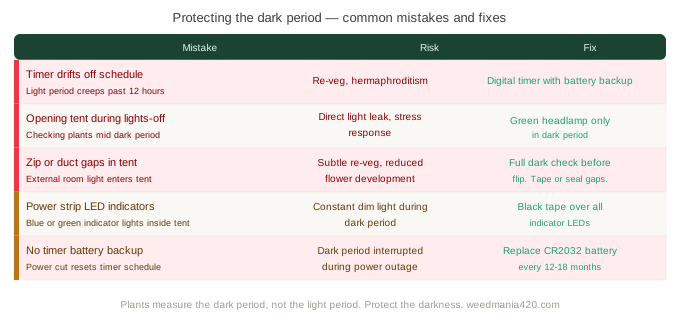
Not checking for light leaks before the 12/12 flip. This is the most common cause of hermaphroditism and re-veg in photoperiod grows. Thirty seconds with a torch inside a zipped tent finds most leaks before they become a problem.
Forgetting the timer battery. A digital timer without a fresh CR2032 battery has no power outage protection. Check and replace it every 12 to 18 months, or after any extended power failure.
Flipping autos to 12/12 thinking it will help. Autoflowers do not respond to the light flip. Running them at 12/12 reduces their daily light dose and produces smaller yields for no benefit unless running them alongside photoperiod plants already on 12/12.
Interrupting the dark period for any reason. Opening the tent during lights-off to check on flowering plants is a light leak in real time. Use a headlamp with a green filter if you must check during the dark period.
Green light does not trigger the plant’s photoperiod response the way white and red light do.
Running 24/0 on photoperiod plants in veg. Some growers assume more light always means more growth. Photoperiod plants need that dark period for healthy development, and continuous light can produce chlorotic, stressed growth that carries into flower.
FAQ
Can I veg photoperiod plants forever at 18/6? Yes. A photoperiod plant will not flower under 18/6 regardless of how long you keep it there. Some growers run mother plants on 18/6 for months, taking clones continuously without ever letting the mother flower. The plant continues in vegetative growth indefinitely until you flip to 12/12.
What happens if I accidentally give my flowering plant 13 hours of light instead of 12? One or two days of slightly longer light exposure is unlikely to cause visible problems in a plant well into flower.
The risk increases the earlier in flower the interruption occurs and the more frequently it happens. A single off day mid-flower is less dangerous than consistent 13-hour days from the start of the 12/12 flip.
Should I change the light schedule for the final two weeks before harvest? Some growers drop to 10/14 or even 11/13 in the final two weeks to simulate late-season light conditions and encourage the plant to finish more aggressively.
This is an advanced technique. The risk is that it can trigger stress responses in sensitive genetics. For a first or second grow, maintaining 12/12 through harvest is the safer approach.
Do autoflowers need a dark period at all? Technically no, since they will flower under 24/0. Practically speaking, a 4 to 6 hour dark period benefits most autos by allowing photosynthetic recovery and keeping tent temperatures lower.
The consensus among experienced autoflower growers, including most breeders, sits at 18/6 or 20/4 as the optimal range rather than 24/0.
My autoflower is not flowering at week four. Is my light schedule wrong? Light schedule is unlikely to be the cause since autoflowers flower based on age. Most autoflowers begin showing pre-flowers between weeks 3 and 5.
Stress from overwatering, overfeeding, or transplant shock is a more likely cause of delayed flowering than the light schedule. Check the autoflower nutrient guide for the environmental conditions that support on-time autoflower development.